This scenario plays out in manufacturing facilities every single day. Most shops collect enormous amounts of data from machines, but lack the infrastructure to turn that data into real-time, actionable visibility. The result? Reactive decisions based on stale information, unplanned downtime that compounds across shifts, and a persistent gap between what's actually happening on the shop floor and what leadership sees in their reports.
This article explains what data visibility in manufacturing really means, what it costs when it's absent, and how manufacturers of any size—including those running legacy CNC machines—can use real-time machine data to drive measurable efficiency gains.
TLDR
- Live machine data means seeing status, production progress, and shop floor activity right now—not at shift's end
- Without visibility, decisions run on stale data—leading to unplanned stops and inaccurate ERP records
- Real-time data cuts bottleneck response time and makes production scheduling far more reliable
- OEE, utilization, and cycle time become trackable when machine data flows automatically
- Legacy machines can connect to visibility systems—no equipment replacement required
What Is Data Visibility in Manufacturing?
Data visibility in manufacturing is the ability to capture, centralize, and view operational data from machines, processes, and people in real time. It gives every level of the organization an accurate picture of what's happening right now, not what happened last shift.
That distinction matters, because it's not the same as basic data collection. Many shops log data through spreadsheets, manual tallies, or machine outputs stored locally. But true visibility means that data is aggregated, interpreted, and presented in a usable format—dashboards that update live, alerts that notify the right person immediately, and reports that inform decisions the moment they're needed.
The Difference Between Collection and Visibility
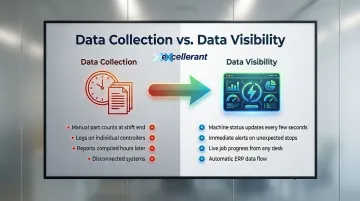
Data collection looks like this:
- Operators manually record part counts at the end of each shift
- Machine logs sit on individual controllers, accessible only at the machine
- Production reports are compiled hours after events occur
- Information lives in disconnected systems across the facility
Data visibility looks like this:
- Machine status updates automatically every few seconds
- Alerts notify technicians the moment a machine stops unexpectedly
- Schedulers see live job progress from their desks
- Production data flows automatically into ERP systems
Shops that make this shift stop chasing problems after they happen—and start catching them before they compound.
The Hidden Cost of Poor Data Visibility
When shop managers rely on manual check-ins, end-of-shift reports, or gut feel to make decisions, they're always reacting after the damage is done. Unplanned downtime now costs Fortune Global 500 manufacturers $1.4 trillion annually—equivalent to 11% of their total revenues. For general industrial manufacturing, the cost ranges from $125,000 to $260,000 per hour depending on the sector.
Operating in the Dark
Without real-time visibility, critical information arrives too late to prevent losses:
- A machine sitting idle for two hours goes unnoticed until the next supervisor walkthrough
- A job running 30% slower than estimated doesn't surface until it misses the delivery deadline
- Quality issues aren't detected until post-production inspection reveals an entire batch of scrap parts
- Maintenance needs aren't identified until catastrophic failure stops production entirely
Data Silos Compound the Problem
When machine data, job status, and scheduling information live in disconnected systems—or on paper—errors multiply. A 2024 survey reveals that 70% of manufacturers still collect data manually, with paper-based workflows consuming up to 3% of total revenue for some companies.
The communication breakdown looks like this:
- The front office schedules work based on yesterday's machine availability
- Operators don't know a rush job was added until the traveler reaches their station
- Estimators quote new work using cycle times that haven't been accurate in months
- Management makes capacity decisions without knowing three machines have been running at 40% utilization
The ERP Accuracy Gap
Without live data feeding into the ERP, production records are only as good as the last manual entry. When operators manually log runtime, programs run, and parts produced, transcription errors accumulate quietly — and by the time that data reaches management, decisions are already based on stale numbers.
The downstream effects compound fast:
- Job costing skews high or low based on incorrect labor and machine time entries
- Delivery estimates miss because quoted cycle times don't reflect current machine performance
- Capacity planning breaks down when utilization data is days behind actual shop floor reality
How Data Visibility Drives Manufacturing Efficiency
Most manufacturers already own the equipment capacity they need. The problem is visibility — or the lack of it. Real-time machine data closes that gap, turning reactive shops into operations that catch problems before they cause downtime.
Faster Response to Machine Downtime
When machines are connected and transmitting status in real time, technicians receive immediate alerts the moment a machine stops unexpectedly. This cuts the time between failure and response. Real-time monitoring systems have been shown to reduce unplanned downtime by 10-30%, while firms using real-time data improve their downtime forecasting accuracy by 85%.
The notification gap matters more than most shops realize. In a traditional setup, a machine stops at 9:15 AM — but the operator is on another task. The supervisor catches it at 10:00 AM. Maintenance gets called at 10:15 AM.
By the time a technician arrives at 10:45 AM, 90 minutes of production time are gone — not because the repair was complex, but because no one knew there was a problem.
Real-time alerts compress that 90-minute gap to minutes or even seconds.
Reduction in Unplanned Stops Through Pattern Recognition
Real-time data, reviewed over time, reveals patterns that manual tracking misses entirely:
- Machines that slow down 10-15% before failing completely
- Specific programs that cause repeated errors or tool breakage
- Tooling that degrades at predictable rates based on material type
- Environmental factors (temperature, humidity) that correlate with quality issues
Predictive maintenance strategies have been proven to reduce unplanned downtime by 30-50% while cutting maintenance costs by 25-40%. This shifts maintenance from reactive firefighting to predictive intervention—fixing issues before they cause downtime.

Improved Scheduling and Throughput
Live visibility into machine availability, job status, and cycle times allows schedulers to make real-time adjustments:
- Redirect work to available machines when bottlenecks appear
- Catch schedule conflicts before they cascade across multiple jobs
- Adjust delivery commitments based on actual production pace, not estimates
- Keep production on schedule without last-minute scrambling
Manufacturers implementing real-time monitoring report a 5-20% increase in output using existing equipment—no capital investment required.
Better Quality Control
When production data is captured continuously, deviations from expected cycle times or output rates surface immediately. An operator can catch a quality issue after 5 parts instead of 500 — correcting it before scrap costs multiply.
Continuous monitoring delivers two additional benefits:
- Early intervention: Deviations trigger alerts before defects propagate across a run
- Root cause clarity: Audit trails make it faster to pinpoint whether issues stem from tooling, programming, material variation, or operator technique
Elimination of Manual Data Entry and Associated Errors
Automated machine data collection removes the human error layer from reporting. Operators no longer log runtime, programs run, or parts produced manually — that data flows directly from the machine to the system.
This frees operators to focus on production while giving management accurate, complete, and timely data. Better data quality doesn't just save time; it changes what decisions are even possible.
Key Metrics That Real-Time Data Visibility Unlocks
Real-time machine data makes previously invisible or estimated metrics trackable, measurable, and actionable.
Overall Equipment Effectiveness (OEE)
OEE is the gold-standard metric for manufacturing efficiency, combining three factors into one number:
- Availability: Percentage of scheduled time the machine is actually running
- Performance: Actual output compared to maximum theoretical output
- Quality: Percentage of parts produced that meet quality standards
Without real-time data, OEE calculations are estimates based on manual logs and operator memory. With live machine data, OEE becomes a true operational pulse that managers can act on daily—or even hourly.
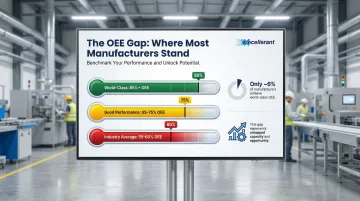
Industry Reality: The reality for most manufacturing organizations is an OEE score closer to 55-60%. "World-class" OEE is defined as 85% or higher, but analysis of 3,500+ machines shows that only roughly 6% of manufacturing organizations achieve this benchmark.
That gap between average and world-class OEE represents enormous untapped capacity—and utilization data is often the first place that lost time shows up.
Machine Utilization Rate
Machine utilization is the percentage of time a machine is actively producing parts versus sitting idle, in setup, or waiting for work. Real-time visibility makes utilization visible at the machine, work center, and facility level—identifying underused assets and guiding capacity decisions.
The 2025 Modern Machine Shop Top Shops survey puts hard numbers on this gap:
| Metric | Top Shops | Average Shops |
|---|---|---|
| Spindle utilization | 74% | 60% |
| Machine hours per day | 15 hrs | 8.5 hrs |
| Sales per machine (annual) | $350,000 | $183,000 |
| Lights-out machining adoption | 71% | 54% |
Top shops don't run harder—they run smarter, using data to extend productive hours and reduce idle time across their floor.
Cycle Time and Production Rate Accuracy
Capturing actual cycle times against programmed cycle times reveals where jobs are running over or underestimate. This improves future quoting accuracy and identifies process improvement opportunities.
Manufacturers that return quotes within two hours have a 90%+ win rate, whereas those taking five days or more see win rates drop to less than 5%. Accurate cycle time data enables faster, more confident quoting—which directly impacts sales effectiveness.
When actual cycle times consistently differ from estimates, it signals opportunities:
- Programs running faster than estimated may indicate conservative quoting that's leaving money on the table
- Programs running slower reveal bottlenecks, tooling issues, or operator technique problems worth investigating
- Variation in cycle times for the same program across different shifts or operators highlights training opportunities
Connecting the Shop Floor to the Front Office
In most manufacturing facilities, the front office—scheduling, estimating, management—is making decisions based on information that is hours or days old. Job status updates, machine utilization, and production counts travel via paper travelers, whiteboard notes, or verbal check-ins during shift changes.
The result is confident-sounding decisions built on unreliable foundations.
The Communication Gap
77% of respondents in a Manufacturing Leadership Council survey noted that data decision-making responsibility falls to plant leaders, yet only 33% said factory floor employees were empowered with that data. This creates a decision latency problem where production adjustments take more than 48 hours to implement—by which time the conditions that prompted the adjustment have often changed.
The disconnect manifests in daily frustrations:
- A customer calls asking about order status, but the front office has no visibility into whether the job is running, waiting, or complete
- Schedulers add a rush job without knowing two machines are already running behind
- Management discusses capacity expansion without realizing existing equipment sits idle 40% of the time
- Estimators quote delivery dates based on assumptions about machine availability that haven't been accurate in weeks
What Changes with Real-Time Machine Data
When machine data flows automatically from the shop floor into connected systems, front office staff can see live job progress, accurate ERP data, and reliable delivery projections without walking the floor or waiting for a shift report.
Customer communication improves immediately, and production forecasting shifts from speculative to reliable. Resource planning decisions rest on actual utilization data rather than guesswork.
Rory Miller from McMellon Bros., a customer using Excellerant's platform, describes the transformation: "ERP has become a more powerful tool. I can pull it up at any time and find out what's happening with a customer's parts. If we're not on pace, we can fix it."
The Legacy Machine Challenge
Gaining visibility across the whole floor raises an immediate concern for many shops: what about older equipment? Many facilities run machines that are 10, 15, or even 20 years old — hardware that lacks Ethernet ports, predates protocols like MTConnect, and was never designed with connectivity in mind.
Modern IIoT solutions can integrate virtually any machine, regardless of brand, age, or control type. Legacy equipment connects through serial communications or via PLCs added as intermediary devices. Shops gain full floor visibility without replacing functional equipment that still produces quality parts.
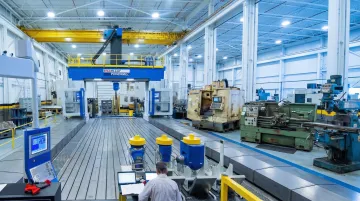
Excellerant's universal connectivity addresses this directly. The platform supports any brand and any protocol: the newest Haas or Mazak machines with native Ethernet, and decades-old Fanuc controls running RS-232 serial connections alike. Over more than 30 years of machine tool networking experience, the team has connected CNC mills, lathes, EDMs, stamping machines, presses, and injection molders across mixed-environment shops.
Tying Data Visibility to ERP Accuracy Improvement
Automated data collection feeds accurate, real-time production data into ERP systems, eliminating manual entry errors, improving job costing, and enabling confident production forecasting that reflects what's actually happening on the floor.
Dan Villemaire from C&M Machine Products experienced this transformation firsthand: "The accuracy of information that's coming into our ERP system is exponentially better than what it was before. We have been able to improve the accuracy of our costs and increase our value to our customers."
When ERP systems receive automated updates on part counts, cycle times, machine status, and job completion, they become dynamic management tools rather than static record-keeping systems.
What to Look for in a Machine Data Visibility Solution
Not all machine monitoring platforms are created equal. When evaluating solutions, prioritize these capabilities:
Compatibility with Mixed Machine Environments
The solution must connect to any machine on the floor—CNC mills, lathes, EDMs, legacy equipment—using whatever protocols those machines support. A solution that only works with the newest equipment leaves most of the shop floor invisible.
Look for platforms that support:
- Modern protocols: MTConnect, OPC UA, Fanuc Focas, HAAS MNET, Mazak Mazatrol
- Legacy connectivity: Serial communications (RS-232), PLC intermediaries
- Universal compatibility: Any brand, make, model, or age
The average age of private manufacturing equipment in the U.S. is approximately 13 years, with over 1.2 million machine tools installed that could be enabled with connectivity. The vast majority require retrofit solutions rather than replacement.
Real-Time Dashboards and Alerting
Visibility is only useful if it surfaces at the right time. Look for solutions that offer:
- Configurable dashboards showing machine status, job progress, and production metrics
- Immediate alerts when machines enter unplanned stop states
- Multi-level views from individual machine detail to facility-wide overview
- Accessible from anywhere so both operators and managers work from the same live picture
Excellerant's monitoring platform covers all of these bases for CNC environments — mobile app notifications, workflow-based alerting, and browser-based access from any device keep the whole team on the same page.
Integration with Existing Systems (DNC, ERP)
Standalone monitoring is valuable, but maximum impact comes when machine data connects to DNC software and ERP systems. This enables:
- Automatic program delivery to machines
- Accurate job tracking without manual entry
- Front-office visibility into shop floor reality
- Bi-directional data flow that keeps all systems synchronized
Excellerant connects to major ERP platforms — including SAP and Oracle — through an Open API architecture, automatically populating production records with part counts, cycle times, machine status timelines, and OEE statistics. That means front-office data reflects actual shop floor activity without manual entry or reconciliation.
Frequently Asked Questions
Frequently Asked Questions
How to improve production efficiency in manufacturing?
Improving production efficiency starts with visibility: knowing where machines are idle, where bottlenecks occur, and how actual cycle times compare to targets. Real-time machine data supports faster, more informed decisions that reduce waste, minimize downtime, and keep jobs on schedule.
How is data analytics used to improve efficiency in manufacturing?
Manufacturers use data analytics to track KPIs like OEE, machine utilization, and cycle time. These patterns reveal inefficiencies, predict failures, and guide scheduling decisions. When data is captured automatically from machines, analytics shift from a historical report into a tool teams can act on immediately.
Why is supply chain visibility important?
Supply chain visibility helps manufacturers anticipate material shortages, align production schedules with actual capacity, and communicate realistic delivery timelines to customers. When shop floor data is accurate and real-time, it feeds into better supply chain planning and reduces the risk of missed commitments.
What is machine data visibility in manufacturing?
Machine data visibility is the ability to monitor CNC and other production machines in real time. It captures status, runtime, program usage, cycle counts, and alerts, then makes that information available to both shop floor personnel and management.
How does real-time machine data reduce downtime?
Real-time machine data reduces downtime by sending immediate alerts when a machine stops unexpectedly, enabling faster response times. Over time, historical machine data reveals patterns that allow maintenance teams to intervene before failures occur, shifting from reactive to predictive maintenance.
Can older CNC machines be connected to a data visibility system?
Yes. Legacy CNC machines can be connected through software and connectivity solutions that support multiple communication protocols. Shops do not need to replace functional equipment to gain data visibility — universal connectivity solutions integrate virtually any machine regardless of age or brand.