Introduction
Midsize manufacturers face a frustrating paradox: they've outgrown spreadsheets and entry-level accounting software, yet they lack the resources to implement enterprise-grade ERP systems like SAP or Oracle. This "midsize manufacturing gap" leaves companies operating with disconnected systems, manual data entry, and limited visibility into production operations—inefficiencies that directly cap output capacity and profitability.
The right ERP system unifies production planning, inventory management, financials, and shop floor data under one platform. According to Panorama Consulting's 2024 ERP Report, 37% of ERP projects exceed their original budget — and failed implementations can consume months of productivity on top of that.
This guide breaks down the top ERP systems built for midsize manufacturers, what to look for before you buy, and how to avoid the implementation pitfalls that derail most projects.
TLDR
- Midsize manufacturers ($10M–$250M revenue) need ERP that scales without enterprise-level complexity or cost
- Top solutions include Epicor Kinetic, Acumatica, Global Shop Solutions, Microsoft Dynamics 365 Business Central, and Syspro
- Key selection criteria: manufacturing-specific features, deployment flexibility, integration capability, and total cost of ownership
- ERP accuracy depends on real-time shop floor data—machine connectivity is critical
- Implementation partner quality often matters as much as the software itself
What Makes ERP Unique for Midsize Manufacturers
The Midsize Manufacturing Gap
Entry-level business software lacks depth for complex production environments. QuickBooks can't handle multi-level Bills of Materials (BOMs), production scheduling across multiple machines, or shop floor control. Meanwhile, enterprise ERPs carry implementation costs that can reach 4% of annual revenue for SAP customers—a $2 million project for a $50M manufacturer.
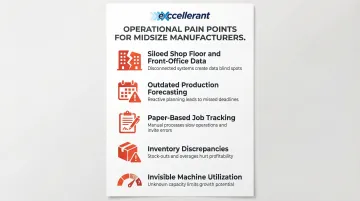
This gap forces midsize manufacturers to cobble together disconnected systems, creating operational pain points:
- Shop floor and front-office data exist in separate silos
- Production forecasting relies on outdated or manually entered information
- Job tracking happens on paper or spreadsheets
- Inventory discrepancies emerge between physical counts and system records
- Machine utilization data remains invisible to planning teams
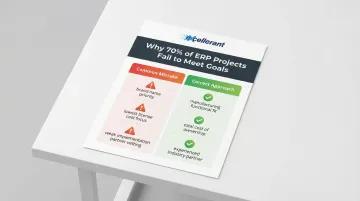
Research indicates that more than 70% of ERP initiatives fail to fully meet their original business goals, with as many as 25% failing catastrophically. That failure rate isn't inevitable — it largely traces back to selecting software built for generic business operations rather than the realities of a manufacturing floor.
Manufacturing-Specific Requirements
Midsize manufacturers need ERP systems built around production workflows, not retrofitted financial software. The features that matter most on the shop floor include:
- Production scheduling that accounts for capacity across multiple work centers
- Work order management with real-time tracking from release to completion
- Shop floor control integrated with machines and operator terminals
- Multi-level BOMs driving accurate material planning and procurement
- Job costing that captures labor, materials, and overhead by individual job
When these capabilities aren't native to the ERP, workarounds become permanent fixtures — and the data gaps that drove the original software decision never actually close.
Top ERP Systems for Midsize Business Growth and Efficiency
The systems below were evaluated based on manufacturing-specific functionality, mid-market fit (company size and budget), deployment flexibility, integration ecosystem, and customer retention—not vendor size or brand recognition alone.
Epicor Kinetic
Epicor Kinetic represents the evolution of the long-established Epicor ERP platform, serving over 23,000 customers globally with a strong focus on discrete manufacturers in the $10M–$100M revenue range.
Key differentiators:
- Purpose-built for complex discrete manufacturing environments
- Strong shop floor control and production scheduling capabilities
- Available in both cloud and on-premise deployment models
- Well-developed partner and implementation ecosystem
- Subscription pricing starts around $125 per user/month
| Feature | Details |
|---|---|
| Best Fit | Discrete manufacturers, $10M–$100M revenue, multi-site operations |
| Deployment | Cloud and On-Premise |
| Starting Implementation Cost | Minimum $50,000 |
Epicor is actively shifting development resources to the cloud, though on-premise deployments remain supported for manufacturers with specific infrastructure or compliance requirements.
Acumatica Cloud ERP
Acumatica has grown rapidly since its 2008 launch, partly because its consumption-based licensing model allows midsize manufacturers to scale user access without per-seat cost penalties—ideal for growing operations that need shop floor workers to access the system.
Key differentiators:
- Cloud-native architecture supporting public, private, and hybrid deployment
- Consumption-based pricing (unlimited users) ranging from $7,500 to $150,000 annually
- Strong manufacturing and field service modules with high configurability
- Active independent software vendor (ISV) ecosystem extending capabilities
- Recognized as a Leader in the IDC MarketScape for SaaS ERP Applications
| Feature | Details |
|---|---|
| Best Fit | Mid-sized discrete manufacturers, $10M–$50M revenue, growth-stage companies |
| Deployment | Cloud (public, private, hybrid) |
| Licensing Model | Consumption-based (not per-user), subscription pricing |
Acumatica's Manufacturing Edition covers BOMs, Production Management, MRP, and Advanced Planning and Scheduling—making it one of the more complete mid-market manufacturing stacks at this price point.
Global Shop Solutions
Global Shop Solutions is a family-owned ERP provider built specifically for small-to-midsize manufacturers since 1976. The system has earned a strong reputation for shop floor control, real-time inventory tracking, and customer-focused support that distinguishes it from larger vendors.
Key differentiators:
- Integrated platform covering shop management, production scheduling, quality control, and CRM
- Available in both cloud and on-premise deployment
- Known for hands-on implementation support and training
- Particularly strong for job shops and make-to-order manufacturers
- Supports 5–500 users with complex modes like engineer-to-order
| Feature | Details |
|---|---|
| Best Fit | Job shops, make-to-order, small-to-mid manufacturers (5–500 users) |
| Deployment | Cloud and On-Premise |
| Key Strength | Shop floor control, real-time inventory, personalized customer support |
Unlike enterprise vendors that hand off post-go-live support to third parties, Global Shop Solutions maintains direct involvement through upgrades and customizations—a meaningful difference for smaller shops without large IT teams.
Microsoft Dynamics 365 Business Central
Microsoft Dynamics 365 Business Central is the modern, cloud-first evolution of Microsoft's long-standing ERP product line (formerly Dynamics NAV, GP, and AX). It offers a cost-effective and widely accessible system suited for manufacturers across most industries and revenue sizes.
Key differentiators:
- Native integration with the broader Microsoft ecosystem (Teams, Azure, Power BI, Office 365)
- Straightforward subscription pricing: $80/user/month (Essentials) or $110/user/month (Premium with Manufacturing modules)
- Strong partner network for implementation and customization
- Serves over 50,000 customers globally
- Lower-risk entry point for manufacturers starting their first ERP implementation
| Feature | Details |
|---|---|
| Best Fit | Small-to-midsize manufacturers across most industries, existing Microsoft ecosystem users |
| Deployment | Cloud (primary), On-Premise available |
| Key Strength | Microsoft ecosystem integration, cost-effectiveness, broad industry applicability |
For manufacturers already invested in Microsoft tools, Business Central offers seamless data collaboration directly within Teams and Excel.
Syspro
Syspro is an ERP platform purpose-built for midmarket manufacturers and distributors, with deep vertical expertise in industries such as metal fabrication, industrial machinery, food manufacturing, and electronics.
Key differentiators:
- Embedded AI, machine learning, predictive analytics, and IoT services
- Strong inventory and warehouse management capabilities
- Flexible architecture accommodating both standard modules and third-party integrations
- Industry-specific implementation methodology tailored to process and discrete manufacturing workflows
- Available in cloud, on-premise, and hybrid deployment models
| Feature | Details |
|---|---|
| Best Fit | Midmarket manufacturers and distributors, process and discrete manufacturing |
| Deployment | Cloud and On-Premise |
| Key Strength | Purpose-built for midmarket, embedded AI/IoT, flexible integration architecture |
Syspro's AI capabilities include anomaly detection and predictive maintenance, helping manufacturers prevent equipment failures before they occur.
Key Features Midsize Manufacturers Should Prioritize in an ERP
Core Manufacturing Modules
Without these features natively integrated, manufacturers are forced back to spreadsheets and workarounds:
- Production scheduling and work order management - Develop schedules based on available workdays and resource capacity
- Bill of Materials (BOM) - Define product structures, components, and relationships for material planning
- Job costing - Track labor, materials, and overhead by job for accurate profitability analysis
- Inventory and warehouse management - Maintain up to 99% accuracy to support Material Requirements Planning (MRP)
- Quality control - Track deviations, support statistical process control, and ensure compliance
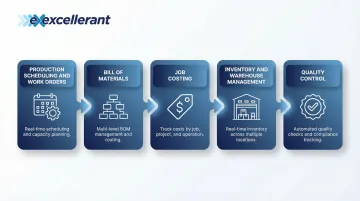
These modules form the foundation of manufacturing planning as defined by APICS/ASCM standards.
The Integration Imperative
Those core modules only deliver value when fed accurate, real-time data. For manufacturers, that means the ERP must integrate directly with shop floor systems, CNC machines, and machine monitoring platforms.
Manual data entry creates costly inefficiencies. Many SMB machine shops operate at only 30–60% Overall Equipment Effectiveness (OEE) due to disconnected systems. Integrating shop floor data with ERP can improve OEE by 10–25% within months while reducing manual logging by 12 minutes per machine per shift.
Solutions like Excellerant's machine monitoring and IIoT connectivity platform feed live machine data directly into ERP systems through standardized protocols including MTConnect, OPC UA, and Fanuc Focas. This bidirectional data synchronization eliminates manual data entry, improves production forecasting accuracy, and ensures business systems always reflect current shop floor reality.
As Dan Villemaire from C&M Machine Products notes, "The accuracy of information that's coming into our ERP system is exponentially better than what it was before."
Deployment and Scalability Considerations
| Deployment Model | Key Advantages |
|---|---|
| Cloud | Lower upfront IT costs; automatic updates; remote access; predictable subscription pricing |
| On-Premise | Greater data control; customization flexibility; no ongoing subscription fees; meets specific regulatory requirements |
| Hybrid | Combines both models; supports phased cloud migration; keeps critical systems on-premise |
Midsize manufacturers should evaluate these options against internal IT capacity, compliance requirements, and growth trajectory. The global cloud ERP market is projected to reach $207.59 billion by 2034, with manufacturing among the fastest-growing segments driving that adoption.
How We Chose These ERP Systems
Evaluation Criteria
We assessed each system based on:
- Covers production scheduling, shop floor control, and BOMs — not just financial modules
- Built for $10M–$250M manufacturers, not scaled-down enterprise systems
- Supports cloud, on-premise, and hybrid deployment
- Implementation cost and timeline realistic for midsize budgets (typically 4–9 months, $10,000–$50,000+)
- Strong customer retention rates with documented long-term satisfaction
- Access to experienced, qualified implementation partners
We excluded systems built primarily for enterprise scale.
The Common Selection Mistake
Those criteria exist because the most common ERP mistake is prioritizing brand name or lowest licensing cost over functional fit, integration capability, and implementation partner quality — a combination that routinely leads to failed rollouts and costly re-implementations.
A well-implemented mid-tier system tailored to manufacturing workflows will outperform a poorly implemented household-name ERP. Gartner predicts that by 2027, more than 70% of ERP initiatives will fail to meet their original business goals — driven by implementation failures, not software limitations.
Evaluate implementation partners as rigorously as the software itself. Look for partners with:
- Specific experience in your manufacturing mode (discrete, process, job shop, make-to-order)
- Documented customer references in similar industries
- Clear methodology for data migration and change management
- Post-go-live support commitments
Conclusion
The right ERP for a midsize manufacturer isn't the most famous or the most feature-rich—it's the one that fits your current processes, can scale with growth, and integrates cleanly with existing shop floor systems and workflows.
Start by shortlisting 2–3 systems based on your manufacturing mode, revenue size, and deployment preference. Then evaluate implementation partners as rigorously as the software itself, checking references and assessing their industry experience before signing contracts.
Maximizing ERP ROI starts with clean, real-time shop floor data. Excellerant's team brings over 30 years of machine tool networking experience, specializing in connecting legacy and modern CNC machines to ERP systems through universal IIoT connectivity. That means your ERP decisions are grounded in live production data, not manually entered estimates.
Schedule a demo to see how machine connectivity improves ERP accuracy on your shop floor.
Frequently Asked Questions
What is the best ERP system for midsize manufacturing companies?
The best ERP depends on your manufacturing mode and revenue size. Epicor Kinetic and Acumatica consistently rank highly for discrete midmarket manufacturers, while Global Shop Solutions and Syspro are strong options for job shops and mixed-mode environments.
How much does an ERP system cost for a midsize business?
Cloud-based ERP typically runs $10,000–$50,000 annually in licensing, with implementation adding another 30–50% of that cost. On-premise installations carry a higher upfront investment ($50,000+) but no recurring subscription fees.
What is the difference between ERP and MES in manufacturing?
ERP manages business-level processes including financials, inventory, scheduling, and HR. Manufacturing Execution Systems (MES) manage real-time shop floor operations. Integrating both gives planners accurate, real-time production data in the ERP — improving scheduling decisions and reporting without manual entry.
How long does it take to implement an ERP for a midsize manufacturer?
Implementation timelines typically range from 3 to 12 months for midsize manufacturers, depending on system complexity, data migration requirements, and implementation partner experience. Cloud-native systems like Acumatica often offer faster deployment paths than traditional on-premise installations.
Can midsize manufacturers integrate ERP with their existing shop floor machines?
Yes, most modern ERP platforms support integration with shop floor systems via APIs or middleware. Specialized IIoT and machine connectivity solutions can connect legacy and modern CNC machines to ERP regardless of brand or protocol, ensuring real-time data accuracy without manual entry.
What are the biggest mistakes midsize companies make when selecting an ERP?
The most common mistakes are:
- Choosing based on brand name or lowest license cost instead of functional fit
- Underestimating implementation complexity and timeline
- Failing to vet the implementation partner's industry experience before signing