Introduction
Manufacturing teams face constant pressure juggling complex job queues, fluctuating demand, machine breakdowns, and tight delivery windows. Traditional scheduling methods—spreadsheets, static ERPs, manual Gantt charts—fall short when reality diverges from the plan. A machine goes down, a rush order arrives, or a tool breaks, and the entire schedule becomes obsolete.
That's exactly the gap AI-driven production scheduling tools are built to close. They use machine learning, constraint-based logic, and real-time shop floor data to optimize production sequences—and keep recalculating as conditions change, not just when a planner remembers to update a spreadsheet.
This article covers what AI scheduling tools are, the 5 best options for manufacturing environments, and what to look for when evaluating them against your operation's specific constraints.
Key Takeaways
- AI-driven production scheduling tools automatically sequence jobs, allocate resources, and minimize downtime using algorithms and real-time data
- The 5 tools covered: PlanetTogether APS, Siemens Opcenter APS, Plex Smart Manufacturing Platform, Infor CloudSuite Industrial, and Delfoi Planner
- Key evaluation criteria: AI/ML scheduling depth, ERP/MES integration, real-time machine data handling, and scalability
- Live machine data is foundational; without it, AI schedulers optimize against assumptions rather than actual shop floor conditions
- Best fit varies by operation size — some tools suit large enterprises, others mid-sized job shops and CNC environments
What Is AI-Driven Production Scheduling?
AI-driven production scheduling is software that uses machine learning, constraint-based optimization, and real-time input—machine status, job priorities, material availability—to automatically generate and adjust production schedules. This contrasts sharply with static MRP or manual Gantt-based scheduling.
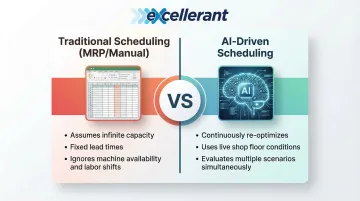
Traditional scheduling creates a plan once and breaks when reality changes. The gap comes down to how each approach handles constraints:
- MRP systems assume infinite capacity and fixed lead times, ignoring machine availability and labor shifts
- AI schedulers continuously re-optimize based on live conditions
- Multiple scenarios are evaluated simultaneously, balancing demand against finite capacity
That continuous re-optimization is only possible with accurate, real-time data. AI scheduling tools are only as effective as the inputs feeding them. Shop floor IIoT platforms that collect live machine status, cycle time, and downtime data provide the foundation AI schedulers need. Without this layer, scheduling algorithms fall back on theoretical assumptions rather than actual production reality. Platforms supporting protocols like MTConnect, OPC UA, and FANUC FOCAS can connect both modern and legacy CNC machines to deliver that live data across any machine brand or age.
5 Best AI-Driven Production Scheduling Tools for Manufacturing
These tools were selected based on AI/ML scheduling depth, integration capabilities, manufacturing industry focus, and verified deployment in real production environments. The list covers options from mid-market job shops to enterprise manufacturers — so there's a meaningful range depending on your operation's scale and complexity.
PlanetTogether APS
PlanetTogether is a dedicated Advanced Planning and Scheduling (APS) platform designed for discrete and process manufacturing. It integrates natively with major ERPs including SAP, Oracle, Microsoft Dynamics, Infor, and Kinaxis.
Its AI-powered "what-if" scenario modeling lets planners simulate multiple scheduling alternatives simultaneously and compare outcomes before committing — a critical differentiator for high-mix, low-volume manufacturers dealing with frequent order changes.
| Aspect | Details |
|---|---|
| Key AI Features | Constraint-based finite capacity engine (machine, labor, tooling) |
| AI-driven bottleneck detection with visual constraint identification | |
| Real-time reschedule triggers based on shop floor feedback | |
| ERP/MES Integration | SAP (ECC, S/4HANA, Business One), MS Dynamics (AX, NAV, 365), Oracle (NetSuite, EBS, ERP Cloud), Infor (SyteLine, M3), Kinaxis Maestro, AVEVA, Plex MES |
| Best For | High-mix, low-volume manufacturers in food & beverage, chemical, medical/life sciences, and discrete manufacturing requiring finite capacity scheduling |
Siemens Opcenter APS (formerly Preactor)
Siemens Opcenter APS is a long-established platform (originally Preactor, rebranded in January 2020) with a strong global footprint in automotive, aerospace, electronics, and industrial manufacturing.
Where it differs from most APS tools is its tiered product architecture — from entry-level Opcenter Planning through Opcenter Scheduling to specialized versions like Opcenter Scheduling SMT for electronics. Manufacturers of different sizes can adopt AI-driven scheduling without over-specifying or paying for capabilities they don't need.
| Aspect | Details |
|---|---|
| Key AI Features | Finite capacity scheduling across material, machine, and labor constraints |
| Constraint and priority rules engine (optimize for delivery, utilization, or inventory) | |
| Predictive optimization via multi-scenario evaluation before changes occur | |
| ERP/MES Integration | Native with Siemens Opcenter Execution Discrete (MES); integrates with SAP and third-party ERPs for order and inventory data exchange |
| Best For | High-volume discrete manufacturers in automotive, aerospace, electronics, and consumer products requiring detailed short-term sequencing |
Plex Smart Manufacturing Platform (Rockwell Automation)
For manufacturers who want scheduling and execution in a single system, Plex takes a different approach. It's a cloud-native platform by Rockwell Automation (acquired for $2.22 billion in 2021) that combines MES, ERP, and AI-driven production scheduling in one unified environment for discrete and process manufacturers.
Unlike standalone APS tools, Plex closes the loop between scheduling and execution. Its AI scheduling layer receives real-time machine data from the shop floor and continuously updates the schedule based on actual production status — not just planned data — within a single-instance, multi-tenant SaaS architecture.
| Aspect | Details |
|---|---|
| Key AI Features | Finite Scheduler applies constraint-based algorithms across equipment, tooling, and labor availability |
| Automatic real-time adjustments for resource changes (e.g., equipment downtime) | |
| Machine learning for demand forecasting accuracy | |
| ERP/MES Integration | Native combined MES+ERP+QMS platform; supports third-party ERP connections for manufacturers not on full Plex ERP |
| Best For | Mid-to-large manufacturers in automotive parts, metal fabrication, electronics, food & beverage, and aerospace seeking a unified cloud platform over point-solution APS |
Infor CloudSuite Industrial (SyteLine)
Infor CloudSuite Industrial (formerly SyteLine) is an ERP platform built specifically for industrial manufacturers, with AI-driven production scheduling embedded through Infor's Coleman AI engine. It excels in make-to-order and engineer-to-order environments.
The AI scheduling capability is embedded directly within the ERP rather than bolted on — meaning material availability, capacity, and demand signals all share one data model. This eliminates the sync lag that's common with standalone APS integrations.
| Aspect | Details |
|---|---|
| Key AI Features | Coleman AI predicts maintenance issues and adjusts schedules to avoid unplanned downtime |
| AI/ML demand forecasting feeds directly into the scheduling engine | |
| Embedded APS functions as a core ERP application (not a bolt-on) | |
| ERP/MES Integration | Scheduling natively embedded within the ERP data model; integrates with Infor MES to orchestrate and track shop floor operations |
| Best For | Mid-to-large ETO and MTO manufacturers in industrial machinery, aerospace, discrete manufacturing, process manufacturing, and batch industries |
Delfoi Planner
Delfoi Planner is a visual APS tool designed specifically for high-mix discrete manufacturers and job shops, with strong traction in metal fabrication, CNC machining, and contract manufacturing environments.
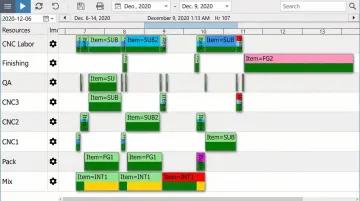
Of the five tools on this list, Delfoi has the lowest barrier to adoption for shops coming off spreadsheets. Its AI-assisted visual scheduling board lets planners drag, adjust, and accept AI recommendations in real time — making it a natural fit for CNC-heavy environments that need usability as much as intelligence.
| Aspect | Details |
|---|---|
| Key AI Features | Intelligent workload balancing and real-time optimization to minimize idle time |
| Interactive Gantt chart with drag-and-drop schedule adjustment | |
| Finite scheduling and rescheduling for machine efficiency and tooling constraints | |
| ERP/MES Integration | Tested integrations with SAP, Oracle NetSuite, and Microsoft Dynamics 365; open REST API for connectivity with any ERP, MES, or data platform |
| Best For | Job shops, CNC machining centers, and contract manufacturers seeking accessible AI scheduling with project scheduling and workforce planning in one platform |
How We Chose These AI Scheduling Tools
Tools were assessed specifically for the presence of AI/ML scheduling logic (not just rules-based automation), real-time data responsiveness, proven manufacturing deployment, and ability to integrate with existing ERP/MES or shop floor data systems. We excluded tools marketed as "AI" that function purely as static optimizers.
Common selection mistakes manufacturers make:
- Choosing tools based on ERP vendor defaults rather than scheduling capability depth
- Underestimating the importance of real-time machine data connectivity
- Selecting enterprise-grade platforms that exceed operational complexity and budget for the facility size
The right tool must match operational context. A 20-machine CNC job shop has fundamentally different scheduling constraints than a 500-machine automotive plant — and AI scheduling ROI depends on matching tool sophistication to actual complexity. Unplanned downtime costs process industries over $1 trillion annually, making that match critical for capturing real value.
That value is only realized when the underlying data is trustworthy. Data quality is the primary reason APS implementations fall short — systems must account for shop floor reality, not just theoretical capacity. Accurate, timely machine data isn't optional; it's the foundation every scheduling algorithm depends on.
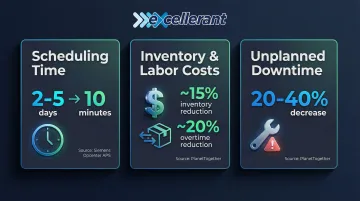
Verified ROI benchmarks from successful implementations:
- Scheduling time reduced from 2-5 days to 10 minutes (Siemens Opcenter APS)
- Inventory overhead cut by ~15% and overtime labor costs reduced by ~20% (PlanetTogether)
- AI-driven predictive maintenance and scheduling can decrease unplanned downtime by 20-40%
Conclusion
AI-driven production scheduling is no longer a luxury for large OEMs. Mid-sized manufacturers, CNC job shops, and contract manufacturers can now access purpose-built tools that use real-time data and machine learning to eliminate the manual scheduling bottleneck.
The best AI scheduling tool is only as effective as the quality of machine data flowing into it. Shops with fragmented or manual data collection will see limited AI scheduling benefit. Investing in real-time machine connectivity is a foundational step—MTConnect-enabled devices provide the structured, contextualized data that scheduling applications need to move beyond theoretical cycle times to actual production status.
Manufacturers looking to build that data foundation can explore how Excellerant's machine tool networking and IIoT solutions connect legacy and modern CNC machines to deliver real-time status, cycle time, and availability data to their scheduling platform. Excellerant brings to that work:
- 30 years of machine tool networking experience — connecting any brand, any protocol, new or legacy
- MTConnect Standards Committee voting membership — ensuring compatibility with the data standard AI schedulers depend on
- Universal connectivity that feeds real-time machine data directly into your scheduling platform
Frequently Asked Questions
What is AI-driven production scheduling in manufacturing?
AI-driven production scheduling uses machine learning algorithms and real-time shop floor data to automatically sequence jobs, allocate machine capacity, and reoptimize plans when conditions change. Unlike static MRP or manual Gantt scheduling, AI schedulers continuously adjust based on actual production reality.
How does AI improve scheduling accuracy compared to traditional methods?
AI schedulers process multiple constraints simultaneously—machine availability, tooling, material, operator shifts—and continuously adjust based on live data. Traditional methods create a fixed plan that becomes inaccurate the moment the first exception occurs, while AI adapts in real time to maintain schedule validity.
Can AI production scheduling tools integrate with existing ERP systems?
Yes, most leading APS tools offer native or API-based integration with major ERPs including SAP, Oracle, Infor, and Microsoft Dynamics. Bi-directional data sync between the ERP and the scheduling engine is critical for accurate material and capacity planning.
What size of manufacturing operation benefits most from AI scheduling tools?
Enterprise platforms suit high-volume, multi-site operations, while mid-market tools like Delfoi Planner and PlanetTogether are purpose-built for job shops and contract manufacturers with 10-100 machines and high-mix, low-volume production.
Why does real-time machine data matter for AI production scheduling?
AI scheduling algorithms require accurate, live inputs—machine status, cycle time actuals, downtime events—to generate valid schedules. Without live machine data, the AI is scheduling against assumptions rather than reality, reducing the reliability of its output and undermining ROI.
What is the typical implementation timeline for an AI scheduling tool?
Standalone APS tools for job shops can go live in as little as two weeks, though most projects take a few months. Enterprise platforms embedded in full ERP replacements can take 12-18 months, with most manufacturers seeing meaningful improvements within 3-6 months of go-live.