Introduction
Manufacturers invest heavily in sensors, automation, and ERP systems expecting operational transformation. Yet a persistent gap remains: 54.4% of small-to-mid-sized manufacturers still rely on manual methods like pen, paper, and spreadsheets for production tracking, despite having access to IIoT technology.
Machine data often never reaches the people who need it most — leaving efficiency gains unrealized and downtime costs mounting.
Smart factory software bridges this gap by connecting shop floor machines, production data, and frontline teams in real time. The real challenge is choosing the right platform. Your decision depends heavily on your machines, workflows, and integration needs, especially when legacy CNC equipment is part of the mix.
This guide covers what you need to make that decision:
- Which smart factory platforms stand out — and why
- What to look for when evaluating software for your facility
- How each solution handles legacy CNC equipment and integration
TL;DR
- Smart factory software connects machines, people, and processes to reduce downtime and improve OEE through real-time data visibility
- Platform options span full MES/ERP suites to targeted machine connectivity tools; the right fit depends on your machine mix and scale
- Legacy machine compatibility is critical — many platforms can't support older CNC equipment without expensive retrofits
- Evaluate platforms on real-time visibility, protocol support, ERP integration, and total cost of ownership
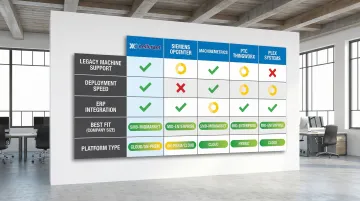
- This list includes Excellerant, Siemens Opcenter, MachineMetrics, PTC ThingWorx, and Plex Systems
What Is Smart Factory Software (and Why It Matters for Modern Manufacturers)
Smart factory software is the technology layer that connects physical machines, production data, and business systems: it delivers real-time visibility, automated data collection, and informed decision-making across the shop floor.
The market reflects the urgency of this shift. The global smart manufacturing market was valued at $410.68 billion in 2025 and is projected to reach $1.06 trillion by 2033, growing at a compound annual rate of 12.1%. Software accounts for over 50% of this market, underscoring its role as the central nervous system of modern production.
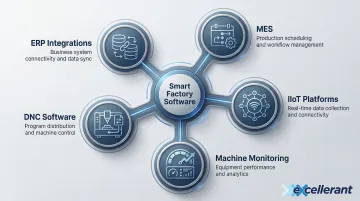
Smart factory software spans multiple categories, and most manufacturers need a combination of tools—each serving distinct but complementary roles:
- MES (Manufacturing Execution Systems) — production scheduling and work order management
- IIoT platforms — machine connectivity and sensor data aggregation
- Machine monitoring software — real-time OEE tracking and downtime analysis
- DNC software — CNC program transfer and revision control
- ERP integrations — shop floor data feeding business planning systems
The sections below help you evaluate which solutions fit your environment, with a focus on machine connectivity, deployment practicality, and real-world manufacturing constraints.
Top Smart Factory Software Solutions for Manufacturing Efficiency
Each solution below was evaluated on machine connectivity capability, deployment track record, legacy equipment support, real-time data features, and industry adoption across discrete and CNC manufacturing environments.
Excellerant
Excellerant is a Connecticut-based IIoT and machine tool networking specialist with over 30 years of experience. The company's roots trace back to 1991, and its founder developed the world's first wireless DNC connection in 2001. Today, Excellerant offers real-time machine data collection, DNC software, and shop floor visibility tools for CNC-heavy environments of all sizes.
Excellerant's core strength is universal machine connectivity across any brand or protocol, including legacy machines. The platform supports MTConnect, OPC UA, Fanuc Focas, HAAS MNET, Mazak Mazatrol, and older serial protocols like RS232. Key platform capabilities include:
- Integrated DNC software with one-click revision compare
- Wireless connectivity options for mixed-age equipment
- Unlimited client access with no per-user licensing fees
- USA-based support team with direct access to the technical team
This makes Excellerant especially suited for machine shops, aerospace, defense, and medical device manufacturers running mixed-age equipment fleets.
| Attribute | Details |
|---|---|
| Key Features | Real-time machine monitoring, wireless DNC, MTConnect support, ERP data integration, shop floor-to-office communication |
| Best For | CNC machine shops and manufacturers needing connectivity for legacy and new machines without complex IT infrastructure |
| Deployment | Scalable for small-to-large shops; USA-based technical support; no per-user licensing fees |
Siemens Opcenter
Siemens Opcenter is an enterprise-grade Manufacturing Execution System (MES) that connects digital design workflows with physical production through digital twin integration. It links PLM (Product Lifecycle Management) to automation, creating a complete digital twin that spans design, production, and performance.
Opcenter's strongest capabilities are design-to-manufacture traceability, advanced scheduling, and quality management. It targets large, complex operations in automotive and aerospace that have the engineering resources and budget for deep implementation. Siemens holds a significant share of the enterprise MES market, with Opcenter deployed across automotive, aerospace, and high-tech sectors globally.
| Attribute | Details |
|---|---|
| Key Features | Digital twin integration, production scheduling, quality management, MES/MOM capabilities |
| Best For | Large-scale automotive, aerospace, and high-tech manufacturers requiring design-to-production traceability |
| Deployment | Enterprise-level; requires significant IT infrastructure and specialized implementation expertise |
MachineMetrics
MachineMetrics is a cloud-based machine data analytics platform focused on real-time CNC and PLC connectivity. It gives manufacturers live visibility into machine performance metrics like load, speed, cycle time, and OEE. The platform offers plug-and-play connectivity for major controllers (Fanuc, Mitsubishi, Haas, Siemens, Heidenhain) and supports MTConnect, OPC-UA, and Modbus.
Where MachineMetrics stands out is speed to insight — automated OEE reporting and real-time dashboards surface granular machine-level data quickly. That said, it relies on integrations with other platforms to handle downstream workflows like maintenance, scheduling, and ERP synchronization. This makes it a strong point solution that typically pairs with a broader MES or CMMS.
| Attribute | Details |
|---|---|
| Key Features | Real-time OEE tracking, CNC/PLC connectivity, machine utilization analytics, production dashboards |
| Best For | Manufacturers seeking deep machine performance analytics and visibility without full MES deployment |
| Deployment | Cloud-based; relatively fast to deploy; integration-dependent for full workflow coverage |
PTC ThingWorx
PTC ThingWorx is an industrial IoT application development platform that allows manufacturers to build custom smart factory applications. It connects sensors, machines, and enterprise systems through a highly flexible low-code/no-code environment. ThingWorx integrates deeply with Vuforia, PTC's AR suite, to create augmented reality work instructions that overlay digital data on physical equipment.
ThingWorx offers near-infinite customization and is a go-to for enterprise manufacturers with dedicated development teams. Its flexibility supports both cloud and on-premise deployments. However, its complexity makes it less suitable for mid-size shops looking for fast deployment without a dedicated internal development team.
| Attribute | Details |
|---|---|
| Key Features | Custom IIoT app development, sensor integration, AR-enabled work instructions, enterprise connectivity |
| Best For | Large enterprises with internal development capabilities seeking fully customized IIoT environments |
| Deployment | Developer-platform model; high flexibility, high implementation complexity and cost |
Plex Systems (by Rockwell Automation)
Plex is a cloud-based MES and ERP platform purpose-built for discrete and process manufacturing. It offers end-to-end production visibility from the shop floor through supply chain and financial reporting. Rockwell Automation acquired Plex for $2.22 billion in 2021 to expand its industrial cloud offering, and the platform now serves over 700 customers.
Plex's core strength is tying production execution directly to ERP and quality data within a single cloud platform — combining MES, ERP, supply chain planning, and quality management in one system. That depth makes it a strong fit for mid-to-large manufacturers looking to unify operations. Implementation timelines are a factor to plan for: full-suite deployment typically spans several months.
| Attribute | Details |
|---|---|
| Key Features | Cloud MES/ERP, production tracking, quality management, supply chain visibility, shop floor data collection |
| Best For | Mid-to-large discrete manufacturers seeking a unified cloud platform for production and business operations |
| Deployment | Cloud-native; full-suite deployment typically spans months; deep ERP integration required |
How We Chose the Best Smart Factory Software
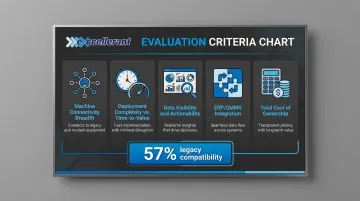
Solutions were assessed on real-world applicability for manufacturing environments, with a focus on several critical factors:
- Machine connectivity breadth, especially legacy CNC compatibility
- Deployment complexity vs. time-to-value
- Data visibility and actionability
- Integration with existing ERP or CMMS systems
- Total cost of ownership, including licensing and support models
57% of manufacturers cite legacy machine compatibility as a critical factor in MES selection—yet many platforms require modern machines with standard protocols or costly retrofits to function. Shops that prioritize brand recognition or feature breadth over actual floor-level connectivity often end up with software that can't talk to half their machines.
That compatibility gap hits hardest at the shop level. The right fit for a 20-machine CNC job shop looks nothing like the right fit for a large automotive OEM—factors like wireless connectivity, DNC compatibility, and no-per-seat licensing can be decisive. LNS Research confirms that manufacturers consistently rank ease of integration and total cost above advanced features, which is why those criteria anchor this evaluation.
Conclusion
The best smart factory software is the one that actually connects to your machines, surfaces data your team can act on, and fits how your operation already runs — not the priciest option or the one with the longest feature list.
Unplanned downtime costs the automotive sector $2.3 million per hour, and costs in heavy industry have quadrupled since 2019. The ROI for machine monitoring software is often realized in months simply by reducing unplanned downtime through predictive alerts and faster response times.
Before committing to a platform, evaluate vendors against:
- Your specific machine mix and communication protocols
- Ability to support legacy equipment alongside modern CNC assets
- Integration requirements with existing ERP or MES systems
- Realistic onboarding timelines and support availability
Start with connectivity and data collection as your foundation, then layer in execution and analytics as your digital maturity grows.
For CNC-focused machine shops and job shops looking for an IIoT and machine connectivity partner, Excellerant brings over 30 years of machine tool networking experience and universal protocol support for any machine brand or age. Reach out to the Excellerant team for a consultation to discuss your specific requirements.
Frequently Asked Questions
What is smart factory software?
Smart factory software is a category of tools that connect machines, production systems, and business data to enable real-time monitoring, automated data collection, and data-driven decision-making across manufacturing operations. It bridges the gap between physical equipment and digital business systems.
How does smart factory software improve manufacturing efficiency?
Smart factory software reduces unplanned downtime through real-time machine monitoring, eliminates manual data entry errors, improves OEE visibility, and enables faster response to production bottlenecks. Industry research shows the average large plant experiences 25 downtime incidents per month, losing roughly 27 hours of production time — losses that smart factory software is designed to surface and address.
What is the difference between MES and IIoT platforms?
MES (Manufacturing Execution Systems) manage production workflows, work orders, and quality enforcement. IIoT platforms connect machines and sensors to collect and transmit data for applications like predictive maintenance. Most smart factory implementations use both: IIoT supplies the data layer, MES orchestrates production.
Can smart factory software connect to older or legacy CNC machines?
Compatibility varies by platform. Some solutions require modern machines with standard protocols like MTConnect or OPC-UA. Specialized tools like DNC and IIoT connectivity platforms (such as Excellerant) are designed to work with legacy equipment across multiple brands and protocols, including older serial connections like RS232, often without costly retrofits.
How long does smart factory software implementation typically take?
Deployment timelines range widely—from a few weeks for focused machine monitoring or DNC solutions to several months or more for full MES/ERP platforms. Complexity scales with the number of machines, integration points, and customization required. Cloud-native solutions generally deploy faster than on-premise enterprise systems.
What is DNC software and how does it fit into a smart factory?
DNC (Distributed Numerical Control) software manages the transfer of CNC programs between computers and machine tools. In a smart factory, it serves as a foundational connectivity layer: handling program version control, machine communication, and shop floor data collection. Modern DNC systems have evolved well beyond simple file transfer to include machine monitoring and real-time data collection.