Introduction
Most machine shops are drowning in data — yet unplanned downtime, blind spots in OEE, and disconnected shop floor systems remain daily realities. The cost of this disconnect is staggering: unplanned downtime in discrete manufacturing now averages $47,000 per hour, contributing to $50 billion in annual losses across US manufacturers alone. Industrial IoT (IIoT) monitoring solutions serve as the critical bridge between raw machine output and actionable intelligence, transforming data streams into decisions that reduce downtime and improve throughput.
Not every platform handles legacy machines, mixed-protocol environments, or ERP integration equally well. This guide ranks the top 5 IIoT monitoring solutions for 2026 based on machine connectivity breadth, real-time monitoring capabilities, integration maturity, and proven results on the shop floor.
TL;DR
- IIoT monitoring collects real-time machine data to cut unplanned downtime, raise OEE scores, and give production managers reliable data to act on
- Key selection criteria: legacy + modern CNC support, protocol compatibility (MTConnect, OPC-UA, FOCAS), and ERP/MES integration
- Top 5 solutions for 2026: Excellerant, MachineMetrics, Scytec DataXchange, Forcam FORCE Bridge, and JITbase
- Most shops run a mix of old and new machines — platforms that can't connect legacy equipment will leave gaps in your data
What Is IIoT Monitoring and Why It Matters for Smart Manufacturing
Industrial IoT monitoring refers to hardware and software systems that connect CNC machines, production equipment, and sensors to a centralized platform. From there, the platform collects and transforms raw machine data into dashboards and reports that operators and managers use to make production decisions.
These systems typically track:
- Machine status and availability
- Utilization rates and cycle times
- Performance metrics and OEE scores
- Downtime causes and durations
The business case is compelling. Beyond the $47,000 hourly cost of unplanned downtime, the global IIoT market is projected to reach $286.3 billion by 2029 (growing at 8.1% CAGR), with some estimates placing it as high as $1.69 trillion by 2030. Those numbers reflect a direct business need: manufacturers are under pressure to get more output from existing equipment without adding headcount or capital.

The section below evaluates the five most capable and field-proven IIoT monitoring platforms available to manufacturers in the US and Canada in 2026. Each was selected based on connectivity breadth, analytics depth, protocol support, and real-world shop floor performance.
Top 5 Industrial IoT Monitoring Solutions for Smart Manufacturing in 2026
These five solutions were selected based on machine connectivity breadth, real-time monitoring capabilities, integration maturity, and proven results in production environments.
Excellerant
Excellerant brings over 30 years of machine tool networking experience to IIoT—tracing back to Macdac Engineering in 1991 and the development of the world's first wireless DNC connection in 2001. Today, the platform covers real-time machine data collection, wireless DNC, and integrated CNC program management for environments ranging from small job shops to aerospace and defense facilities.
Universal machine connectivity is the core differentiator: any brand, any protocol, legacy or modern CNC equipment. As a voting member of the MTConnect Standards Committee, Excellerant maintains deep protocol expertise while eliminating costly cabling infrastructure through wireless DNC technology.
Two practical advantages stand out for growing shops:
- USA-based technical support with direct access to the team that built the platform
- Unlimited client licenses — no per-seat fees as you scale access across operators, supervisors, and management
Excellerant fits shops running mixed or legacy machine fleets that need proven connectivity across hundreds of real-world production environments.
| Attribute | Details |
|---|---|
| Key Features | Universal machine connectivity (legacy + modern CNC), real-time OEE dashboards, wireless DNC, integrated CNC program management with one-click revision compare, shop floor to ERP data sync |
| Best Fit | CNC job shops, aerospace manufacturers, defense contractors, medical device manufacturers in the US and Canada with mixed-brand machine environments |
| Connectivity Protocols | MTConnect, OPC UA, Fanuc FOCAS, HAAS MNET, Mazak Mazatrol, proprietary wireless DNC, supports any machine brand or controller generation |
MachineMetrics
MachineMetrics is a cloud-native IIoT platform built specifically for discrete manufacturers, offering real-time machine monitoring, OEE tracking, and AI-driven production analytics. The platform distinguishes itself through an extensive library of pre-built machine adapters that enable fast deployment, with some customers reporting installations running in less than 15 minutes.
The cloud-first architecture enables access from any location, while AI-assisted downtime classification automatically categorizes production interruptions — cutting the manual work of tracking root causes. Customer results back this up: Avalign Technologies achieved a 30% increase in OEE, Morgan Olson reached 72% machine utilization, and Paragon Medical doubled capacity without adding machines.
For mid-to-large discrete manufacturers with newer CNC equipment, MachineMetrics delivers analytics depth with deployment speed that few platforms match.
| Attribute | Details |
|---|---|
| Key Features | Real-time OEE, AI downtime classification, production analytics, pre-built machine connectors, cloud dashboards, self-install edge platform |
| Best Fit | Mid-to-large discrete manufacturers with newer CNC equipment seeking analytics-heavy platforms |
| Connectivity Protocols | MTConnect, OPC UA, Fanuc FOCAS, Haas, Heidenhain, Siemens Sinumerik, Mitsubishi, Modbus, Ethernet IP, UMATI |
Scytec DataXchange
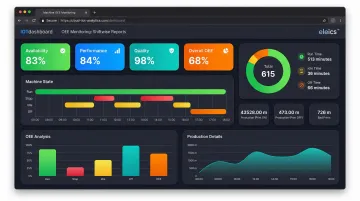
Scytec DataXchange is a long-established machine monitoring platform focused on CNC data collection, OEE reporting, and production floor visibility. Widely deployed across job shops and contract manufacturers in North America, the platform has built a reputation for reliability and depth of CNC-specific features.
The platform covers broad CNC brand support with deep controller integrations, detailed shift and operator reporting, and flexible deployment — on-premise, commercial cloud, or secure cloud. Deployment timelines accommodate shops that need to show ROI quickly rather than running a months-long implementation project.
Small-to-mid-size CNC job shops and contract manufacturers will find DataXchange a solid fit for proven, CNC-specific monitoring with comprehensive protocol coverage.
| Attribute | Details |
|---|---|
| Key Features | CNC machine data collection, OEE and utilization reporting, shift-level analytics, operator dashboards, on-premise or cloud deployment |
| Best Fit | Small-to-mid-size CNC job shops and contract manufacturers looking for proven, CNC-specific monitoring |
| Connectivity Protocols | MTConnect, OPC UA, Fanuc FOCAS, Siemens, Haas, Okuma, Mazak, Heidenhain, RS-232 for legacy equipment |
Forcam FORCE Bridge
Forcam is a global MES and IIoT platform provider with deep roots in high-volume discrete manufacturing. FORCE Bridge serves as their IIoT connectivity layer, linking machine data to MES, ERP, and analytics systems in real time. The platform acts as middleware containing a library of plug-ins for specific CNCs and PLCs, normalizing machine signals into standardized states.
Most IIoT platforms stop at the machine — JITbase extends visibility to the people running it.
The platform ties operator scheduling and workload tracking directly to live machine status — so job assignments reflect what's actually running, not what was planned yesterday. Edge deployment options support on-premise data control and lights-out production. Results from Leesta show what that looks like in practice: machine uptime climbed from 51% to 64%, and operators moved from managing 2 machines to 3 with confidence.
CNC shops running lights-out operations or managing operator allocation across multiple machines will get the most from JITbase's unified approach.
| Attribute | Details |
|---|---|
| Key Features | Live machine dashboards, OEE tracking, operator scheduling, job tracking, lights-out production support, edge platform for local data control |
| Best Fit | CNC shops prioritizing both machine utilization and workforce/operator management in a unified platform |
| Connectivity Protocols | MTConnect (port 5000), Fanuc FOCAS (port 8193), OPC UA, Haas (MTConnect port 8082), Heidenhain |
How We Chose These IIoT Monitoring Solutions
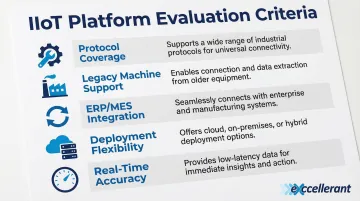
We evaluated each solution on machine connectivity breadth, protocol compatibility, real-time data accuracy, ERP/MES integration depth, deployment flexibility, and documented results in production environments. These criteria reflect what actually determines success on the shop floor — not marketing claims.
Critical evaluation criteria include:
- Protocol coverage — MTConnect and OPC UA handle modern machines; FOCAS, MNET, and similar proprietary protocols determine whether your entire fleet connects or just the newer equipment
- Legacy machine support — Serial communications, PLCs, and proprietary adapters let you connect 10-20 year old equipment without forced replacement
- ERP/MES integration — Bidirectional sync with SAP, Oracle, and similar systems cuts manual data entry and sharpens production forecasting
- Deployment flexibility — Cloud, on-premise, and edge options matter most for defense contractors and others operating under CMMC or similar compliance requirements
- Real-time accuracy — When a machine stops or a quality issue emerges, operators need data in minutes — latency of even 30 minutes can mean a scrapped run
A common mistake buyers make is prioritizing UI aesthetics or brand recognition over actual protocol depth and legacy machine support. This leads to costly integration gaps discovered only after purchase, when teams realize the platform can't connect to half their equipment without expensive hardware upgrades or workarounds.
The five solutions below were selected because they address these criteria across a range of shop sizes, machine mixes, and deployment environments.
Conclusion
Choosing the right IIoT monitoring solution comes down to one practical question: can it connect every machine on your floor—including legacy equipment—and turn that data into decisions that reduce downtime, improve throughput, and support accurate production forecasting?
Evaluate solutions based on your specific machine mix, protocol requirements, and integration needs rather than brand recognition or feature checklists. Request live demos or pilot programs before committing, and insist on testing connectivity with your actual legacy equipment, not just modern CNCs.
Excellerant's team brings 30 years of machine tool networking experience to manufacturers connecting any mix of legacy and modern equipment. Reach out to discuss your specific connectivity challenges and deployment requirements.
Frequently Asked Questions
What is IIoT monitoring in smart manufacturing?
IIoT monitoring connects machines, sensors, and production equipment to a centralized software platform that collects real-time data on machine status, utilization, and performance. This enables manufacturers to track OEE, identify downtime causes, and make data-driven production decisions rather than relying on manual reporting or gut instinct.
How do IIoT monitoring solutions connect to legacy CNC machines?
Legacy CNC machines connect via edge devices or data collectors that read signals like spindle load, program status, and alarm codes, then translate them using protocols like MTConnect or proprietary adapters. Platforms like Excellerant support universal connectivity across legacy and modern equipment using serial communications or PLCs—no machine replacement required.
What is the difference between IIoT monitoring and a traditional MES?
IIoT monitoring focuses on real-time machine data collection and floor-level visibility, while a Manufacturing Execution System (MES) is a broader operational layer managing production scheduling, quality control, and ERP integration. Most IIoT platforms act as the connectivity layer between machines and enterprise systems, feeding data into an MES rather than replacing it.
What KPIs should manufacturers track with an IIoT monitoring solution?
Core KPIs include OEE, machine utilization rate, unplanned downtime frequency, cycle time versus standard, and first-pass yield. The best platforms let operators drill from fleet-level OEE down to individual machine or shift-level root causes to pinpoint bottlenecks.
How long does it typically take to implement an IIoT monitoring system on a shop floor?
Timelines vary by platform and machine count. Shop-floor-focused solutions can go live in days to a few weeks, while enterprise MES-integrated deployments may take several months. Legacy machine compatibility and available protocols are the most common factors that extend timelines.
Can one IIoT platform work with machines from multiple brands and controllers?
Yes, the best IIoT monitoring platforms support multi-brand, multi-protocol environments. Solutions that support MTConnect, OPC UA, Fanuc FOCAS, and proprietary CNC protocols can connect mixed-brand floors without requiring equipment upgrades. This capability is especially important for shops with long-standing legacy assets where machine replacement isn't economically feasible.