Introduction
Unplanned downtime and hidden performance losses are costing discrete manufacturers billions annually. For machine shops running mixed environments—legacy CNC equipment alongside modern machining centers—measuring equipment effectiveness has never been more difficult to get right. Industrial downtime costs manufacturers up to $500,000 per hour, with U.S. manufacturers collectively losing up to $207 million weekly.
OEE (Overall Equipment Effectiveness) software has evolved into the primary way manufacturers gain data-driven visibility into Availability, Performance, and Quality. Choosing the wrong platform, though, leads to poor adoption, incomplete machine coverage, and wasted investment — especially when legacy equipment simply won't connect to modern cloud-based systems.
This guide evaluates five leading OEE software solutions for discrete manufacturing environments in 2026: what differentiates each platform, how they handle mixed-age machine connectivity, and which fits your operation best.
TL;DR
- OEE software measures Availability × Performance × Quality to reveal how effectively equipment runs versus its theoretical maximum
- The average discrete manufacturer operates at just 66.8% OEE—meaning one-third of manufacturing time is non-productive
- Solutions in this guide range from cloud-native platforms for modern fleets to legacy-ready systems built for mixed-age shop floors
- When comparing options, prioritize machine connectivity breadth, deployment speed, real-time visibility, and ERP/DNC integration
- Excellerant stands out for CNC shops that need universal machine connectivity, integrated DNC, and wireless file management in one platform
What Is OEE and Why Does It Matter for Manufacturing?
OEE is a KPI that multiplies Availability × Performance × Quality into a single percentage representing how close a machine or line runs to its theoretical maximum output.
What the scores mean in practice:
- 65-70%: Typical for discrete manufacturing—significant improvement opportunity
- 75-80%: Above average—demonstrates good operational control
- 85%+: World-class benchmark—achievable but requires sustained discipline
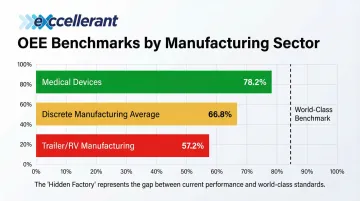
Research shows the average discrete manufacturer operates at 66.8% OEE, with medical device manufacturers leading at 78.2% and trailer/RV manufacturers trailing at 57.2%. This performance gap represents a massive "hidden factory" of untapped capacity.
Where the losses occur:
The dominant efficiency killer in discrete manufacturing is unplanned downtime, which accounts for 34.2% of all efficiency losses. Setup and changeover time adds another 28.7%, meaning nearly 63% of losses stem from Availability issues rather than speed or quality problems.
OEE software makes those losses visible in real time, giving operations teams the data to act before problems compound. The right platform connects shop floor activity to front office decisions—enabling manufacturers in machine shops, metal fabrication, aerospace, defense, and medical devices to identify bottlenecks, prioritize improvements, and forecast production with confidence.
Top 5 OEE Software Solutions for Manufacturing in 2026
These platforms were selected based on machine connectivity breadth, real-time monitoring capability, ease of deployment, integration with existing shop systems, and proven value in discrete manufacturing environments.
Excellerant
Excellerant is a Connecticut-based manufacturing technology company with 30+ years of machine tool networking experience, offering a real-time machine monitoring and OEE platform purpose-built for CNC environments. The company pioneered the world's first wireless DNC connection to machine tools in 2001 and has since developed the only integrated wireless DNC connection on the market.
What sets it apart:
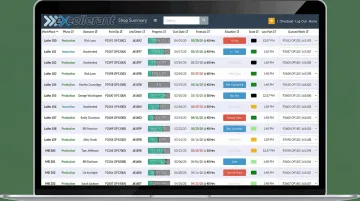
Excellerant connects any machine—regardless of brand, age, or protocol—to a single monitoring platform, eliminating data blind spots caused by legacy equipment. The platform supports MTConnect, OPC UA, Fanuc Focas, HAAS MNET, Mazak Mazatrol, and dozens of other protocols, including serial communications for vintage machines.
Legacy CNCs connect through wireless DNC adaptors that interface with RS232 serial connections, bringing decades-old equipment into the modern ecosystem.
The USA-based support team and unlimited client access model (no per-user licensing fees) make it a practical choice for machine shops serving aerospace, defense, and medical device sectors where compliance and traceability matter.
The platform includes Rev-Lock-Load features that enforce one-program-per-machine requirements for AS9100 and ISO 13485 environments, plus Active Directory integration for secure access control.
| Category | Details |
|---|---|
| Key Features | Real-time machine data collection and visualization, integrated DNC software with one-click G-code revision compare, wireless DNC connection technology, universal machine connectivity (any brand/protocol), shop floor to ERP data integration, 2-way API for MES/ERP synchronization |
| Best For | CNC machine shops, aerospace and defense contractors, medical device manufacturers, facilities with mixed legacy and modern machine environments needing both OEE monitoring and DNC program management |
| Pricing / Deployment | Contact Excellerant for custom quote; USA-based technical support, no per-user licensing fees, deployable across facilities of all sizes in the US and Canada |
MachineMetrics
MachineMetrics is a cloud-based industrial IoT platform designed primarily for discrete manufacturing and CNC machining environments, offering deep data extraction directly from machine PLCs and controllers to deliver granular OEE insights.
What sets it apart:
MachineMetrics pulls cycle-level data directly from modern machine controls and automatically categorizes downtime using machine-generated fault codes. Edge devices with custom software adapters unlock and standardize data across diverse equipment, supporting MTConnect, OPC-UA, and other industrial protocols.
Morgan Olson, a walk-in van producer, achieved a 20% increase in utilization across all assets using MachineMetrics, improving from a baseline of 40-50% to 72% during the trial phase. The platform functions as an "Intelligent MES" powered by machine data, making it a practical fit for shops with newer CNC equipment and dedicated technical resources to manage PLC integration.
| Category | Details |
|---|---|
| Key Features | Automated downtime categorization from PLC data, cycle time analysis, real-time OEE dashboards, integration with ERP systems, machine utilization reporting, edge device connectivity |
| Best For | Shops with modern CNC machines and controls, facilities with dedicated IT or controls engineering resources, manufacturers prioritizing deep machine-level data granularity |
| Pricing / Deployment | Contact vendor for pricing; requires PLC integration which may extend deployment timelines for mixed or legacy equipment environments |
Vorne XL
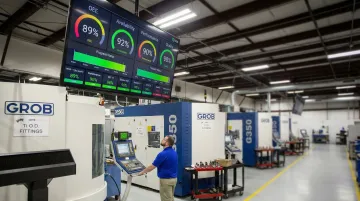
Vorne is widely recognized in discrete manufacturing for its XL Productivity Appliance, a hardware-first OEE solution that delivers real-time production counts, downtime tracking, and OEE scores directly on the shop floor through large-format visual displays.
What sets it apart:
The XL Productivity Appliance excels at immediacy and simplicity—operators and supervisors see live OEE data at the machine without logging into software. The hardware-centric approach enables deployment in as little as 8 hours by connecting to just one or two sensors on the line, providing 140+ metrics and 64+ built-in reports without complex IT integration.
The XL810-1 model is transparently priced at $4,490 as a one-time cost, making budgeting straightforward. A glass products manufacturer reduced shift downtime from 160 minutes to just 10-12 minutes (a 94% reduction) using the real-time visual feedback. However, its analytical depth and multi-part cycle handling may require customization for complex manufacturing environments.
| Category | Details |
|---|---|
| Key Features | Real-time OEE scoreboard displays, automated production counting, downtime reason capture, shift performance reporting, configurable alert thresholds, hardware-based data collection |
| Best For | Manufacturers prioritizing on-floor visual management, facilities seeking a simple hardware-based OEE solution without complex software infrastructure, operations needing rapid deployment |
| Pricing / Deployment | XL810-1 model: $4,490 one-time cost; hardware installation required at each machine; deployment as fast as 8 hours for basic production monitoring |
Evocon
Evocon is a cloud-based OEE monitoring platform built for simplicity, offering an intuitive interface that allows production teams to track equipment effectiveness, capture downtime reasons, and generate automated performance reports without steep technical onboarding.
What sets it apart:
Teams can begin monitoring production within days — physical installation of IIoT devices and sensors typically takes just a few hours. The platform collects data from sensors and PLCs and transmits it securely to Amazon AWS cloud infrastructure.
HKScan, a food manufacturer, improved OEE scores by an average of 20% in six months on their packaging lines using Evocon. The factory overview functionality supports multi-machine and multi-line visibility in a single dashboard, making it practical for small to mid-sized discrete manufacturers. The per-machine licensing model (not per-user) encourages broader adoption across operations.
| Category | Details |
|---|---|
| Key Features | Automated production, downtime, and speed loss reports; real-time OEE tracking; factory overview dashboard; data comparison tools; shift-level performance breakdowns; cloud-based architecture |
| Best For | Small to mid-sized manufacturers seeking a straightforward cloud OEE solution with minimal IT overhead and fast deployment, operations prioritizing ease of use over deep analytics |
| Pricing / Deployment | Contact vendor for pricing; web-based platform with no dedicated mobile app; physical deployment typically completed in a few hours |
PerformOEE by OEE Systems
PerformOEE is a specialized OEE software platform developed by OEE Systems, designed for manufacturers who need precise, analytics-driven insight into production efficiency—including root cause analysis, continuous improvement dashboards, and detailed bottleneck identification.
What sets it apart:
Where most OEE tools stop at reporting scores, PerformOEE pushes teams to identify and eliminate the root causes of performance losses. The platform is often deployed alongside the "Science of Manufacturing" methodology, built around principles like "Follow the Data" and "Act on the Data" to drive measurable business impact.
Several features support cross-functional and multi-site deployments:
- In-app terminology translator for multi-national teams
- Benchmarking and cost tracking modules
- Downtime tracking and quality control dashboards
- Performance bottleneck identification tools
PerformOEE is best suited for operations with dedicated production engineering resources who will actively use these analytics to drive formal CI programs.
| Category | Details |
|---|---|
| Key Features | Continuous improvement dashboard, root cause analysis tools, in-app technical term translator, performance bottleneck identification, machine uptime optimization analytics, cost tracking modules |
| Best For | Manufacturers focused on structured continuous improvement programs, operations teams with dedicated production engineering resources, facilities where OEE data drives formal CI initiatives |
| Pricing / Deployment | Contact vendor for pricing; web-based platform; requires organizational commitment to actively use deep analytics for improvement initiatives |
How We Chose These OEE Solutions
Selections were evaluated based on five criteria relevant to discrete manufacturing:
1. Machine connectivity breadth (including legacy CNC compatibility)2. Ease and speed of deployment3. Real-time monitoring capability4. Integration with existing shop systems (ERP, DNC, MES)5. Total cost of ownership (including licensing model)
A common mistake buyers make is prioritizing dashboard aesthetics over data accuracy and machine integration depth. The most visually impressive interface delivers no value if it can't connect to half your machines or requires months of PLC programming to extract reliable data.
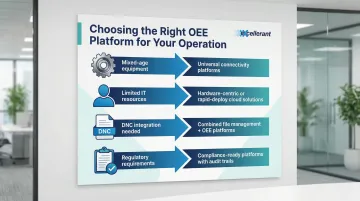
The best OEE software for a given operation depends heavily on machine mix, internal technical resources, and whether the facility needs OEE monitoring alone or an integrated shop floor data ecosystem. Match the solution to your environment:
- Mixed-age equipment? Prioritize platforms with universal connectivity protocols (MTConnect, serial communications, wireless adaptors)
- Limited IT resources? Choose hardware-centric or cloud solutions with rapid deployment (hours to days, not months)
- Need DNC integration? Look for platforms that combine file management with OEE monitoring
- Regulatory requirements? Ensure the platform supports audit trails, revision control, and compliance features
Scalability and licensing structure matter just as much as features. Platforms that charge per-user or per-machine fees can become cost-prohibitive as operations grow. Flat-rate or unlimited access models reduce that friction — encouraging adoption at every level, from operators to management.
Conclusion
OEE software is only as valuable as the data it collects—which means machine connectivity and data accuracy must be the foundation of any selection decision, not feature count or brand recognition. The average discrete manufacturer operates at 66.8% OEE, representing enormous untapped capacity, but capturing that opportunity requires visibility into every machine contributing to production.
The right platform is one that matches both current machine inventory and future operational goals. Evaluate each solution against your specific environment—particularly whether you operate mixed-age machines, require DNC integration alongside OEE, or need a system your operators will actually use on the floor without extensive training.
Need OEE monitoring and DNC networking in one platform? Excellerant connects any machine—legacy or modern—and shows live production status across your shop floor without per-user licensing fees. Contact Excellerant at 860-870-5544 or sales@excellerant-mfg.com to see how their platform handles mixed-age CNC environments.
Frequently Asked Questions
How to improve OEE in manufacturing?
Start by accurately measuring all three components (Availability, Performance, Quality), then address the dominant loss category—typically unplanned downtime. Real-time monitoring surfaces losses as they occur, structured root cause analysis identifies patterns, and preventive maintenance tackles recurring failures before they cause stoppages.
What is a good OEE in manufacturing?
Industry benchmarks place world-class OEE at 85%+, though most manufacturing companies operate closer to 60-67%. A "good" OEE depends on your manufacturing environment—a score that's excellent for high-mix, make-to-order machining (70-75%) may be poor for high-volume, standardized production. Focus on improving your baseline rather than chasing absolute numbers.
Is 100% OEE possible?
100% OEE is theoretically impossible to sustain because it would require zero downtime, zero speed loss, and zero defects simultaneously. Planned maintenance, changeovers, and process variation ensure some losses always exist—which is why world-class operations target 85%+ as a practical benchmark.
What are the three components of OEE?
The three components are Availability (percentage of scheduled time the machine is running), Performance (how fast the machine runs relative to its ideal cycle time), and Quality (percentage of output meeting specifications without rework)—multiplied together to produce the overall OEE score.
How does OEE software integrate with existing CNC machines?
Integration methods vary by platform. Some use PLC/controller data extraction requiring modern controls, while others use non-invasive sensors or machine tool networking protocols like MTConnect or DNC interfaces that work with both legacy and modern CNC equipment. Excellerant supports dozens of protocols—including serial communications for vintage machines. Platforms like MachineMetrics take a different approach, focusing on deep PLC integration for newer equipment.
What is the difference between OEE software and an MES?
OEE software focuses specifically on measuring and improving equipment effectiveness (Availability, Performance, Quality), typically with faster deployment and lower cost. A Manufacturing Execution System (MES) is a broader platform managing production scheduling, work orders, quality enforcement, inventory, and labor—with OEE monitoring often included as one component within the larger suite.